Quick Start | Why sit? | Real Case | Agent Loop | PyPI | Releases
Real case: see how paper-webpage-builder uses Skill-style prompts, schemas, scripts, and golden behavior checks.
A Git-native safety layer for AI agents that edit prompts, schemas, scripts, and Skill packages.
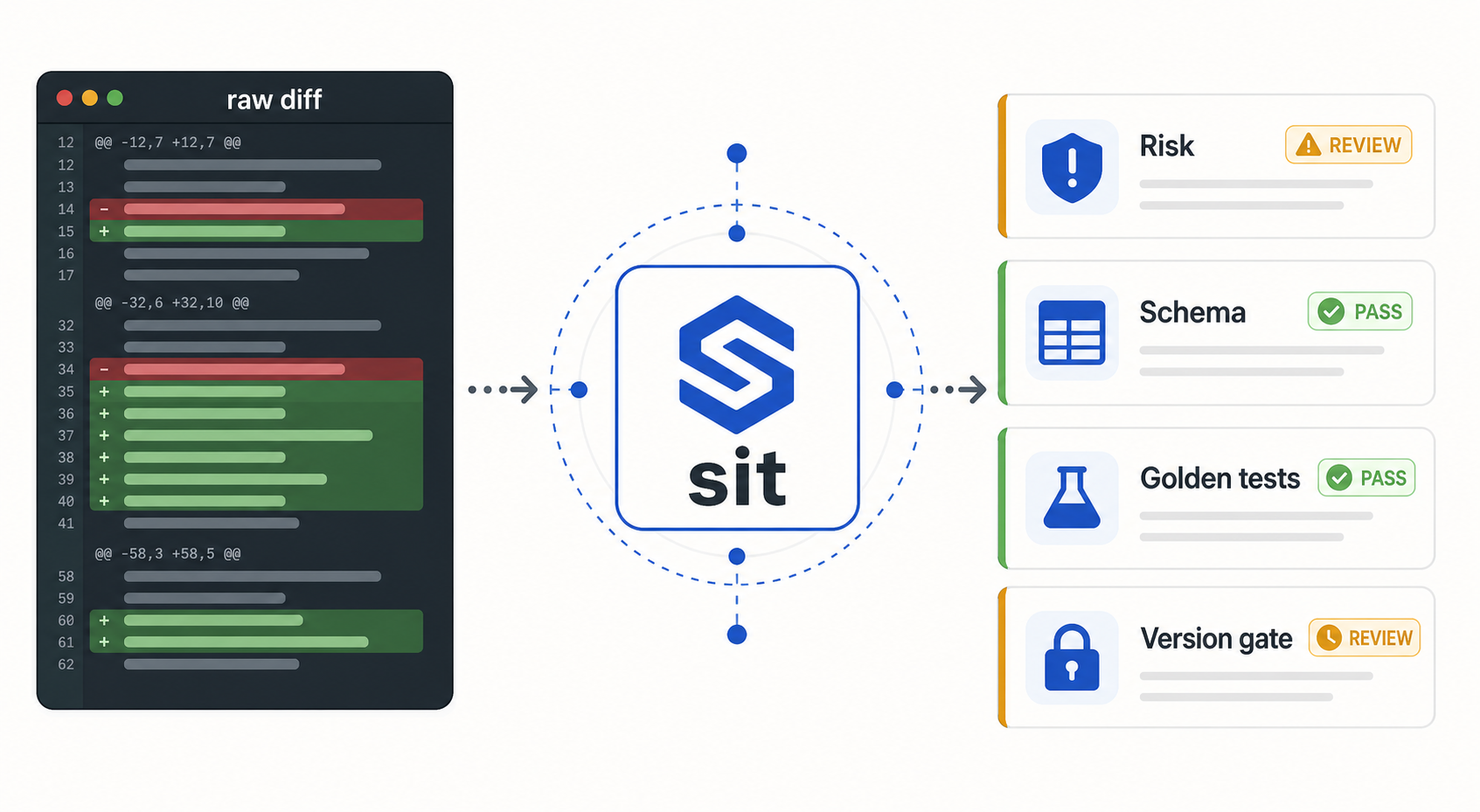
Git can tell you that a prompt changed. sit tells you whether that change is a typo fix, a behavior change, a schema contract change, a test update, or a release risk.
pip install sit-toolkit
sit diff HEAD..WORKTREE
sit review HEAD..WORKTREE
Use sit when humans or AI agents evolve reusable skills and you need semantic diffs, golden tests, version gates, PR reviews, and reproducible releases without replacing Git.
AI Skill packages are not just text prompts. A real Skill often contains:
SKILL.mdand reference instructions- input/output JSON schemas
- golden behavior tests
- validation and asset scripts
- release reports and reproducibility bundles
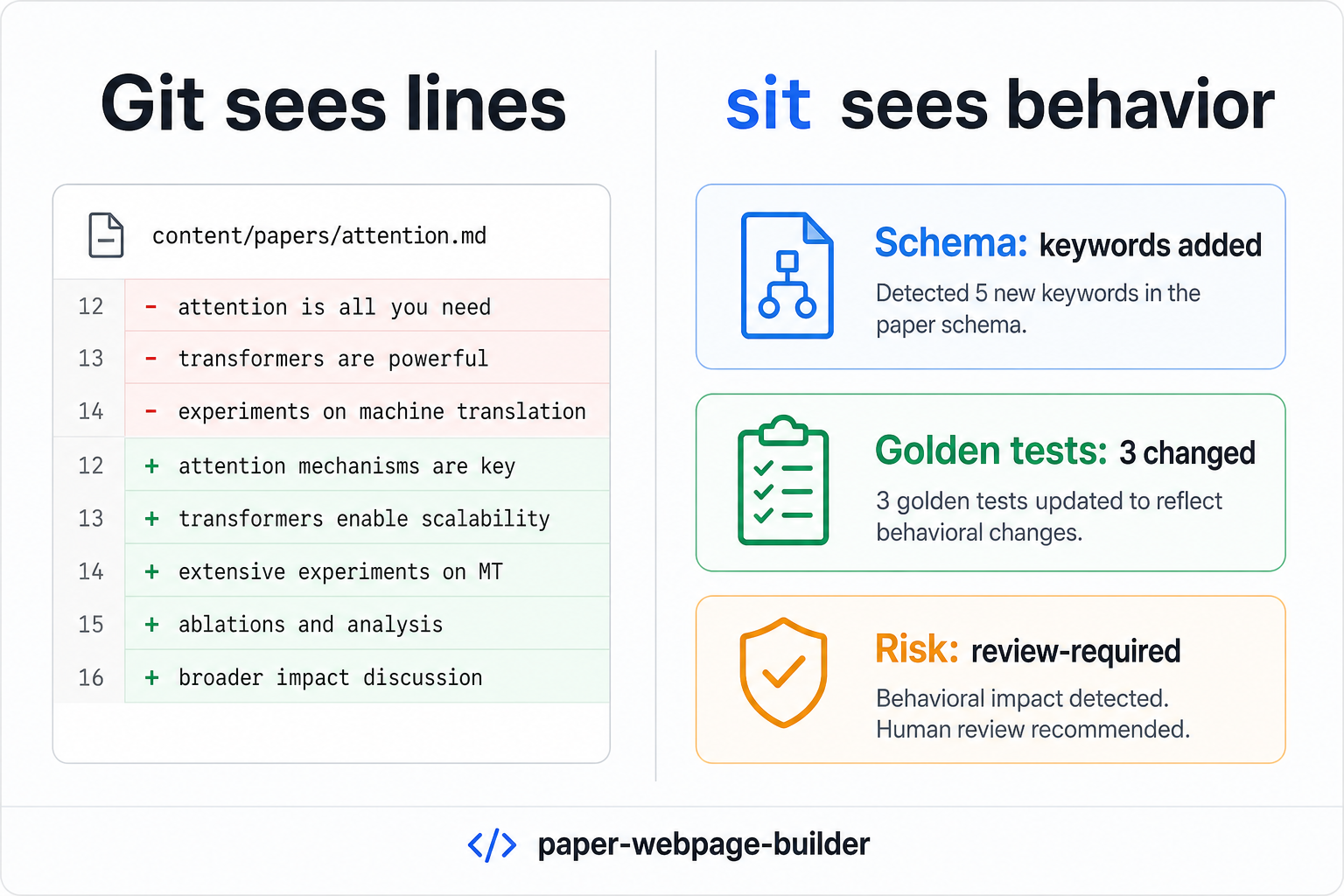
Plain Git sees file lines. sit understands the Skill surface:
SCHEMA output property added keywords (optional)
GOLDEN expected changed latex-project-page
GOLDEN expected changed pdf-with-assets-page
GOLDEN expected changed existing-webpage-refresh
Risk: review-required
Suggested version bump: minor
Golden tests: pass
The example above comes from a real package, paper-webpage-builder, where an agent-facing paper webpage Skill changed its output contract and expected behavior. sit turned the change into a reviewable PR signal instead of leaving reviewers to infer intent from raw diffs.
Start with an existing prompt or Skill project:
pip install sit-toolkit
sit standardize .
sit validate .
sit test .
sit diff HEAD..WORKTREE
sit review HEAD..WORKTREE
Or create a new Skill package:
sit init my-skill
cd my-skill
sit install-hooks .
When the Skill changes, commit through sit:
sit add .
sit commit --bump minor -m "improve webpage quality checks"
sit release minor . --bundle
Git remains the storage and history layer. sit adds the semantic layer: package structure, tests, diffs, version gates, PR summaries, and release reports.
| Change | What sit reports |
|---|---|
| Prompt or reference edits | Changed headings, prompt summaries, behavior risk |
| JSON schema edits | Added/removed properties, required fields, enum changes, breaking risk |
| Golden test updates | Case-level expected output changes and pass/fail status |
| Script changes | CLI args, functions/classes/imports, external commands, review risk |
| Missing version bump | Required bump vs actual bump before commit/release |
| Local dependencies | deps.yaml compatibility and reverse-dependency hints |
| Release reproducibility | Bundle archive, sha256 manifest, reproduce.sh |
sit gives agents a concrete loop after they edit a Skill:
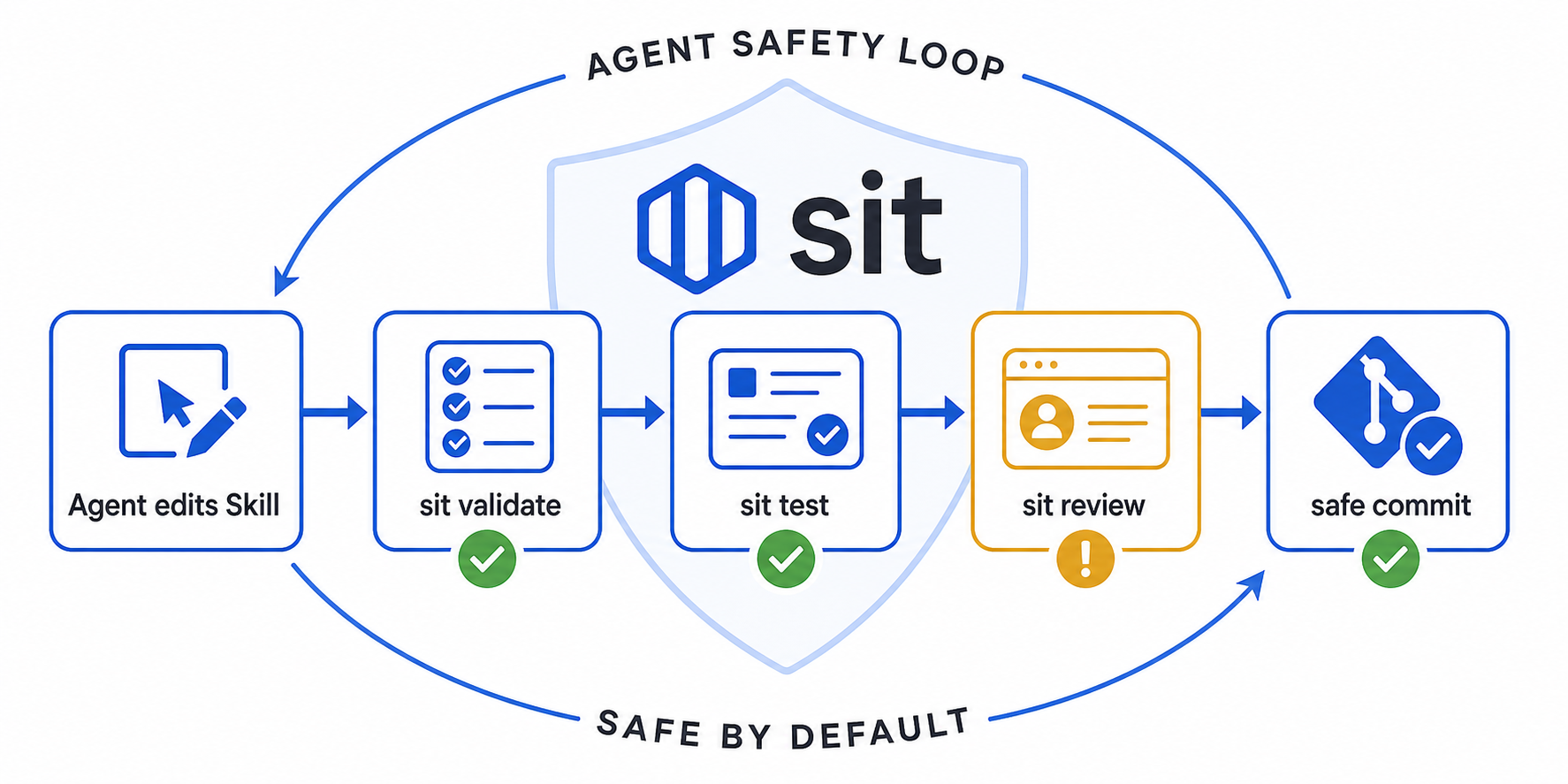
git status --short
sit validate .
sit test .
sit diff HEAD..WORKTREE
sit review HEAD..WORKTREE
One command adds project instructions and MCP configuration:
sit onboard --agent ./my-skillThis creates:
AGENTS.mdfor Codex and other repository-aware agents.mcp.jsonfor MCP-aware editors such as Claude Code and Cursor- a local workflow that asks agents to validate, test, and review semantic changes before handing work back
| Interface | Use it for |
|---|---|
| Auto-discovery | sit onboard --agent for Codex, Claude Code, Cursor, and similar tools |
| Python SDK | from sit.sdk import Sit for direct programmatic calls |
| MCP server | pip install 'sit-toolkit[mcp]' for 12 stdio tools |
| LLM tool-use schemas | from sit.tool_use import get_tools_openai for OpenAI/Anthropic-compatible tool definitions |
Python SDK example:
from sit.sdk import Sit

s = Sit("./my-skill-package")
s.info()
s.validate()
s.test()
s.diff_range("HEAD..WORKTREE")
s.review_range("HEAD..WORKTREE")
s.report_range("HEAD..WORKTREE")
MCP config:
{
  "mcpServers": {
    "sit": { "command": "sit-mcp-server" }
  }
}# Inspect package state
sit info .
sit doctor .
# Validate and test behavior
sit validate .
sit test .
sit test --run
# Review semantic changes
sit diff HEAD..WORKTREE
sit diff --staged
sit review main..HEAD
sit pr-summary main..HEAD
sit report . --compare main..HEAD --format html
# Commit and release safely
sit install-hooks .
sit commit --bump minor -m "update skill behavior"
sit release minor . --bundlesit init generates a GitHub Actions workflow. You can also add the loop manually:
- run: sit validate "$SIT_PACKAGE_DIR"
- run: sit test "$SIT_PACKAGE_DIR"
- run: sit test "$SIT_PACKAGE_DIR" --run
- run: sit ci-summary "$SIT_PACKAGE_DIR" --compare origin/main..HEAD >> "$GITHUB_STEP_SUMMARY"
Current package checks run on Python 3.10, 3.11, 3.12, and 3.13 with ruff, mypy, and pytest.
Lifecycle: sit init, sit standardize, sit onboard, sit doctor
Quality: sit validate, sit test, sit test --run, sit deps check
Diff and review: sit diff, sit review, sit pr-summary, sit report, sit ci-summary
Release and safety: sit install-hooks, sit commit, sit release, sit undo
Git passthrough: sit add, sit push, sit pull, sit branch, sit checkout, sit log
pip install sit-toolkitOptional MCP support:
pip install 'sit-toolkit[mcp]'Requirements:
- Python 3.10+
- Git
- Optional: an MCP-aware editor or agent runtime
sit is currently focused on the local CLI and agent integration loop. It does not replace Git storage, branches, remotes, or merges. Git remains the source of truth; sit adds Skill-aware validation, semantic review, version gates, and release artifacts on top.
Apache-2.0. See LICENSE.