Bilingual Navigation: Versión en Español



Evolith SDLC Tracker is not a task manager. It is an AI-Native E2E Engineering Suite.
It digitizes, automates, and governs the entire Software Development Life Cycle (SDLC),
strictly enforcing the architectural rules defined in Evolith Core.
AI builds and executes. Humans govern and orchestrate.
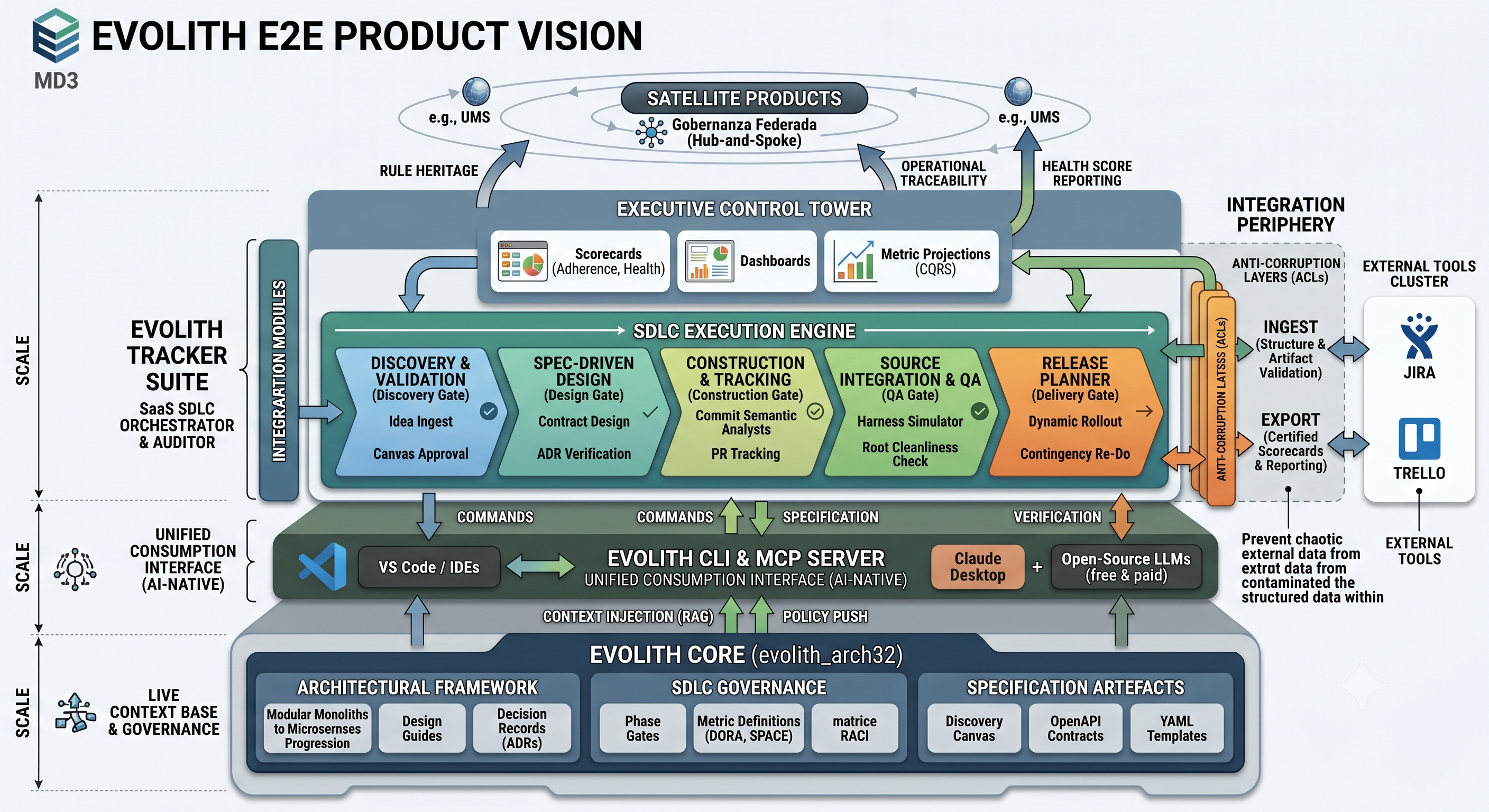
↑ Evolith E2E Product Vision · MD3 — Evolith SDLC Tracker panel highlighted · click to enlarge
| Category | Entry Point | Description |
|---|---|---|
| Master Index | MASTER_INDEX.md | Complete repository navigation |
| Architecture Decisions | DECISIONS.md | Local ADRs & upstream deviations |
| Agent Rules | AGENTS.md | Conventions for AI agents (BMAD) |
| Local ADRs | reference/governance/adrs/ | Product-level architecture decisions |
| Domain Glossary | reference/knowledge/domain/glossary.md | Key domain terms |
| Product Vision | reference/knowledge/domain/PRODUCT_VISION.md | Full product vision & positioning |
| Product Goals | reference/knowledge/domain/product-goals.md | Short & long-term goals |
| Stakeholders | reference/knowledge/domain/stakeholders.md | Stakeholder matrix |
| Upstream Base | Evolith Core | Corporate architecture reference |
Evolith SDLC Tracker is not Jira. Not Trello. Not a glorified to-do list.
It is a 5-module AI-Native engineering suite that enforces the complete software lifecycle as a sequence of mandatory phase gates — from raw business idea to production deployment — with every step governed by the architectural contracts defined in Evolith Core.
Key differentiators:
| Capability | Description |
|---|---|
| AI-Native Execution | Tasks are autonomously executed by BMAD agents; humans govern and approve |
| Spec-as-Source | No code is written before an OpenAPI/ADR contract is approved |
| Architecture Drift Index | Real-time monitoring of deviations between spec and actual code |
| DORA & SPACE Metrics | Live engineering health scorecard for leadership |
| Multi-Tenant SaaS | Absolute data isolation per TenantID across all 5 systems |
| Delegated Identity | Authentication and RACI roles consumed from UMS |
Evolith SDLC Tracker supports three operational modes, configurable per SDLC phase:
| Mode | Who Executes | Best For |
|---|---|---|
| Traditional (Human-Driven) | People following Scrum / Kanban / PMI ceremonies | Teams migrating from legacy tooling |
| AI-Native (Agent-Driven) | BMAD AI agents assigned autonomously | Spec-Driven, fully automated pipelines |
| Hybrid | Humans govern; agents execute repetitive tasks | Most production setups |
Example: Discovery phase handled by humans in live sessions; Architecture Spec-Driven phase delegated 100% to AI agents.
Convention over Configuration: All SDLC workflows default to standard agile flows out of the box. Teams override only what their project demands.
The product enforces the SDLC through 5 consecutive phase gates. Each is an independent progressive monolith:
"Prove your ROI before you design a single screen."
A conversational funnel where the AI challenges raw business ideas, demanding measurable ROI and KPIs via the Discovery Canvas format. No feature passes to Design without a validated business case.
"Contracts before code."
Approved features are automatically converted into technical contracts — OpenAPI / AsyncAPI specs and ADRs. Humans approve contracts; agents produce them. Code construction is blocked until specs are signed off.
"Build what was designed, nothing more."
Methodology-agnostic execution engine supporting agile and predictive boards. Monitors in real time that the physical code does not drift from the approved contract. Integrates with Evolith Core ADR governance.
"Quality is a gate, not a phase."
Deep integration with .harness. Executes contract tests, enforces quality gates, and validates root-level cleanliness before any release is promoted. Security (SAST/DAST) and regression tracking included.
"Deploy with confidence, recover with intelligence."
Multi-country, multi-channel deployment dashboard. Crosses release dates against Regression Scores. If a blocker is detected, the AI activates the Re-Do contingency engine, recalculating downstream impacts automatically.
| Pillar | Implementation |
|---|---|
| Monorepo | Nx 22 with npm workspaces — @nx/nest + @nx/react |
| Backend | NestJS — Progressive Monolith with Hexagonal Architecture (Ports & Adapters) |
| Frontend | React — Microfrontends from Day 1 (ADR-006 exception to Upstream Phase 1 topology) |
| Database | Prisma ORM — multi-tenant schema with TenantID isolation |
| Identity | Delegated to UMS — no local auth; RACI roles consumed via SaaS contract |
| Upstream Governance | Inherits all base standards from Evolith Core |
| DDD | Tactical DDD — Small Aggregates pattern; no nested objects in 1:N relationships |
| State Machine | @evolith/workflow-engine injected per aggregate; transitions protected by RequirementChecklist |
| Analytics | CQRS async engine — DORA/SPACE metrics, Architecture Drift Index |
ADR-006: Frontend uses Microfrontends in Phase 1 as a formal exception to the Upstream base topology, enabling independent concurrent deployment of the 5 UI modules. See ADR-006.
# 1. Clone the repository
git clone https://github.com/beyondnetcode/evolith_tracker.git

# 2. Navigate to the project directory
cd evolith_tracker

# 3. Install dependencies (Nx monorepo)
npm install

# 4. Start the application
npm start
Before contributing, read AGENTS.md for agent conventions and DECISIONS.md for local architectural deviations from the upstream base.
Evolith SDLC Tracker is a satellite repository of the Evolith ecosystem. It inherits — and must not reinvent — the standards defined upstream:
| Repository | Role |
|---|---|
| Evolith Core | Upstream base — ADRs, canonical patterns, SDLC governance |
| UMS | Identity provider — AuthN, AuthZ, RACI roles |
| Evolith SDLC Tracker (this repo) | Satellite product — SDLC execution engine |
Governance rule: If a significant architectural improvement is identified during operation, the contribution must be proposed as an ADR to Evolith Core. The Tracker inherits the improvement only after the upstream approves it. Local deviations must be registered in DECISIONS.md.
Before contributing:
- Read AGENTS.md — agent rules and conventions
- Check DECISIONS.md — understand what is inherited vs. overridden
- Consult Evolith Core ADR Registry before proposing any new technology or pattern
- Register any architectural divergence in DECISIONS.md using the
Adopt / Extend / Override / N/Aclassification
| Role | Influence |
|---|---|
| Engineering Team (Humans) | High — usability and workflow integration |
| Corporate Architecture | High — upstream standards compliance |
| PM Agent (BMAD AI) | High — PRDs, backlog, bilingual parity |
| Architect Agent (BMAD AI) | High — TADs, ADRs, OpenAPI specs |
| QA / .harness System | Medium — contract testing, quality gates |
| Product Owners | High — Epic ROI, DORA/SPACE metrics |
Dual licensed. See LICENSE and NOTICE.